ARC
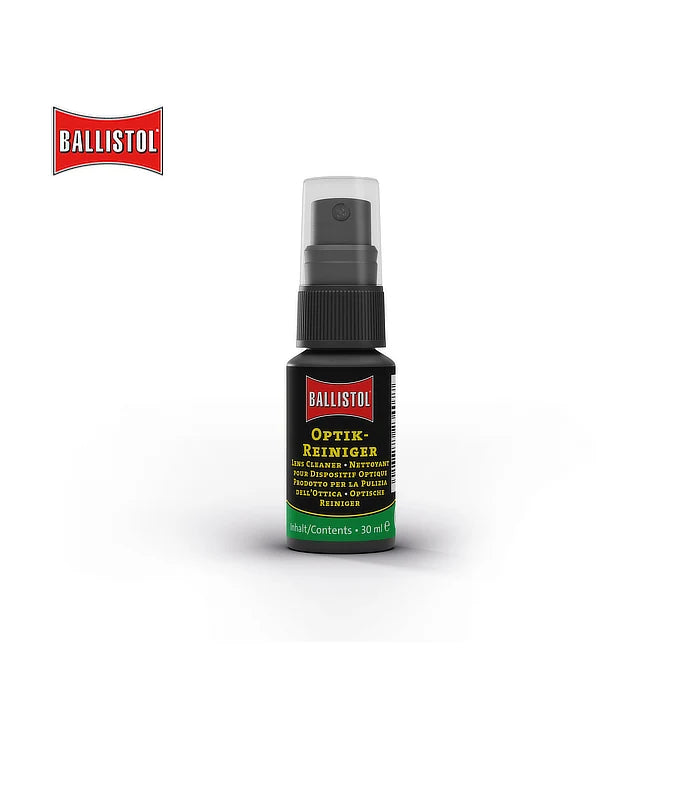
Optics & Lens Cleaner Spray, 30ml
Optics & Lens Cleaner Spray, 30ml
Couldn't load pickup availability
Ballistol Optics Cleaner is a 30ml lens cleaner spray for glasses, binoculars, rifle scopes, camera lenses, telescopes and visors. It lifts fingerprints, smears, dust and dirt. Because it is alcohol-based it evaporates completely, so it leaves no water marks or residue. It was developed with Leica Sport Optics for high-quality optical equipment and is safe on plastic lenses.
The short version: brush or blow off any grit, spray the cleaner onto a clean microfibre cloth, wipe from the centre of the lens outwards, then polish with a dry part of the cloth. Polishing it in also leaves a light anti-fog film, which helps on glasses and scopes in cold, damp weather.
| Size | 30ml spray bottle |
|---|---|
| Works on | Glasses and sunglasses (including plastic lenses), binoculars, rifle and spotting scopes, camera lenses, telescope lenses and eyepieces, helmet visors |
| Finish | Evaporates fully with no water marks; light anti-fog effect when polished in |
| Free from | Silicone, PTFE and acid |
| Developed with | Leica Sport Optics |
| Not for | Contact lenses, or the mirrors of a reflecting telescope |
What can you use a lens cleaner spray on?
Ballistol Optics Cleaner works on most glass and plastic optical surfaces you would otherwise clean with a cloth and a breath. Made in Germany by F.W. Klever, the company behind Ballistol since 1904, it is the same spray shooters use on scopes, and it works just as well on everyday optics.
- Glasses and sunglasses: prescription lenses, reading glasses, safety glasses and shooting glasses, including plastic lenses.
- Binoculars, rifle scopes and spotting scopes: objective and eyepiece lenses. Full method in our rifle scope and binocular cleaning guide.
- Camera lenses: front and rear elements, and viewfinder eyepieces. Always spray the cloth, never the lens, so liquid cannot run behind the front element.
- Telescopes: the objective lens of a refractor, eyepieces and finder scopes.
- Visors and goggles: motorbike helmet visors, ski goggles and face shields.
- In the car: your glasses in the door pocket, and the small lens on a dashcam or reversing camera when road grime blurs the picture.
How do you clean a lens without scratching it?
Most scratches on lenses come from wiping grit across the glass, not from the cleaner. Get the grit off first, then clean.
- Remove loose grit with a blower bulb or a soft lens brush. On waterproof binoculars and scopes you can rinse mud off with clean water first.
- Spray one or two pumps of Optics Cleaner onto a clean microfibre cloth.
- Wipe the lens gently in a spiral from the centre outwards, with very light pressure.
- Polish with a dry part of the cloth until the lens is clear. Repeat once if smears remain.
Skip tissues, kitchen roll and shirt sleeves: they leave fibres and can drag grit across the coating. Wash the microfibre cloth now and then, without fabric conditioner, which leaves a film.
How do you stop glasses and scopes steaming up?
Glasses and scope lenses mist up when they move from cold air into a warm car, house or hide. After cleaning, polish the Optics Cleaner in with a dry cloth rather than wiping it straight off: that leaves a thin anti-fog film, so the lens mists less. Reapply when fogging starts to come back. It works best on a lens that is clean and dry to start with.
How to tell it worked
Hold the lens up to a window or a bright light at an angle. A clean lens shows no rainbow smears, streaks or fingerprint outlines. If you still see a haze, the cloth is probably dirty: switch to a clean part of it and polish again.
Safety
Highly flammable liquid and vapour. Keep away from heat, sparks and naked flames, and use in a well-ventilated area. Causes serious eye irritation, and the vapour may cause drowsiness or dizziness. Do not spray towards your face or anyone else's, and keep out of reach of children. Safety data sheets are in our technical data library.
Questions people ask
Can I use lens cleaner spray on camera lenses? Yes, Ballistol Optics Cleaner can be used on camera lenses. Spray it onto a microfibre cloth rather than the lens so no liquid runs behind the front element, then wipe from the centre outwards.
Is it safe on plastic and coated glasses lenses? Ballistol Optics Cleaner is suitable for plastic lenses and was developed with Leica Sport Optics for high-quality, coated optics. If your optician has given you care instructions for a special coating, follow those.
Can you use optics cleaner on a telescope? Yes, on the objective lens of a refracting telescope, on eyepieces and on finder scopes, applied with a cloth. Do not wipe the mirrors of a reflecting telescope, as their front-surface coating scratches easily.
Does lens cleaner stop glasses steaming up? Polishing Ballistol Optics Cleaner in with a dry cloth leaves an anti-fog film, so glasses and scope lenses mist up less when you come in from the cold. Reapply when the fogging comes back.
Why not just use household glass cleaner on glasses? Household glass cleaner is made for windows, not optical coatings, and tends to streak on lenses. A dedicated optics cleaner on a microfibre cloth cleans the lens and evaporates without leaving marks.
Share